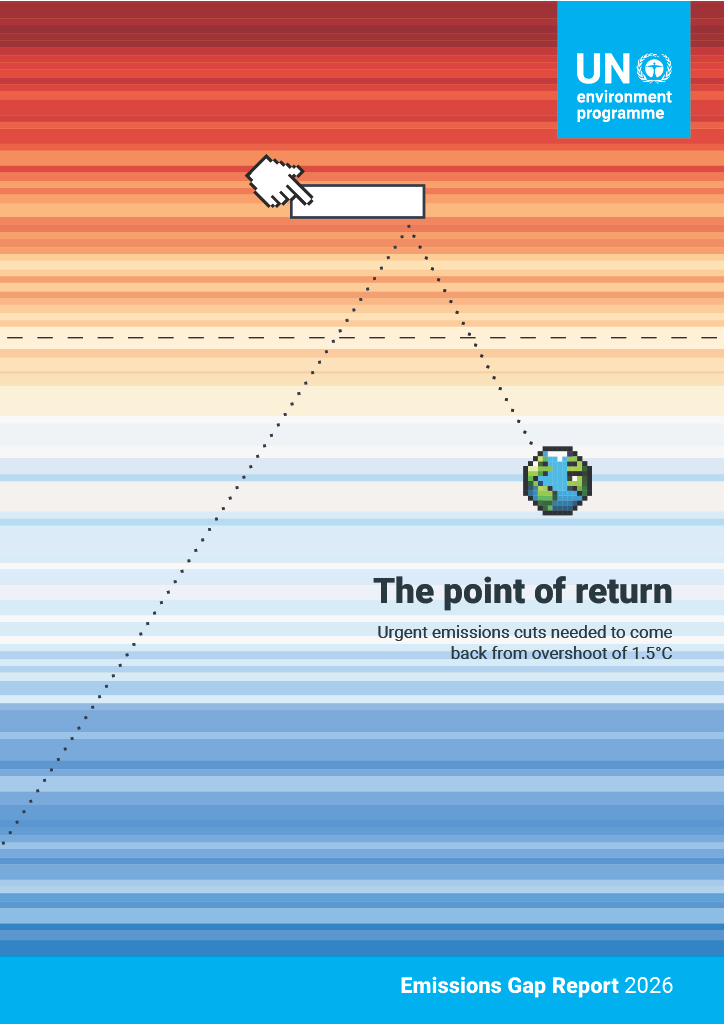
We invite you to join us for an in-person high-level dialogue on accelerating climate action ahead of COP31, drawing on the findings of UNEP’s Emissions Gap Report 2026: The Point of Return.
With global temperatures set to exceed 1.5°C above pre-industrial levels, attention is increasingly turning to how we can minimize the magnitude and duration of overshoot and return warming to 1.5°C by the end of the century. Achieving this will require much deeper and faster emissions cuts than current climate commitments deliver.
The event will feature a presentation of the key findings of the 2026 Emissions Gap Report, followed by keynote interventions and a high-level panel discussion bringing together perspectives from government, business and civil society. The discussion will explore how to scale proven solutions and translate climate ambition into stronger policies and concrete action to help deliver the lowest possible overshoot pathway back to 1.5°C.
From climate science to action
The 2026 Emissions Gap Report assesses the gap between current emissions trajectories and a lowest-possible overshoot of the 1.5°C temperature goal. It finds that global greenhouse gas emissions would need to fall by 18 per cent by 2030, 45 per cent by 2035 and 69 per cent by 2040, relative to 2025 levels, to put the world on track to return global warming to 1.5°C by 2100. Full implementation of current Nationally Determined Contributions (NDCs) fall far short of delivering these reductions.
The report also identifies growing opportunities to accelerate progress. Renewable energy has expanded rapidly since the adoption of the Paris Agreement, climate policies have reduced emissions in many countries, and the growth of coal and oil supply has been slower than projected. Building on the outcomes of the first Global Stocktake, the report sets out updated sectoral benchmarks and highlights opportunities to scale up effective climate action across key sectors.
As countries prepare for COP31 and the next Global Stocktake cycle, the priority is to turn these findings into stronger commitments, effective policies and faster implementation to minimize overshoot and bring global warming back to 1.5°C.
Share this
Where:
UN City Copenhagen
Marmorvej 51, 2100 Copenhagen Ø