As countries move from setting targets to delivering them, Brazil’s Plano Clima offers a practical example of how climate commitments can be translated into sectoral action, monitoring systems, and inclusive governance processes.
The national climate plan, launched by the Government of Brazil in March 2026 and developed through a whole-of-government and whole-of-society process, serves as the country’s roadmap for implementing its NDC and achieving its goal of reducing greenhouse gas emissions and reaching net-zero emissions by 2050.
Behind the plan lies years of technical work, stakeholder engagement, and institutional coordination.
Through a project in Brazil under the Initiative for Climate Action Transparency (ICAT), implemented with technical support from the UNEP Copenhagen Climate Centre, the Ministry of Environment and Climate Change strengthened transparency systems and climate monitoring frameworks that informed the development of Plano Clima.
Building the foundations for climate transparency
As the implementation mechanism of the Brazilian NDC, Plano Clima adopts an economy-wide emission reduction pathway, covering all greenhouse gases, sectors and categories,
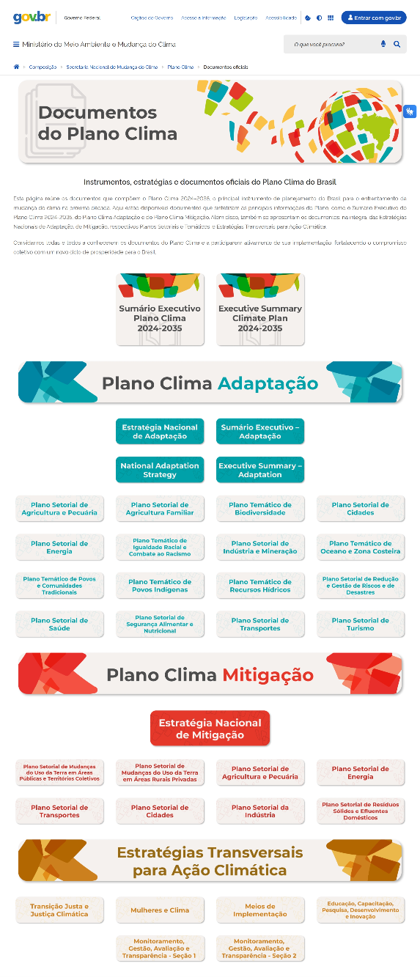
The Plano Clima is built around 16 sectoral and thematic adaptation plans and eight sectoral mitigation plans, which cover energy, industry, transport, cities, waste and wastewater, agriculture and livestock, and land use change for public and private areas respectively.
Each mitigation sectoral plan comes with targets, action plans, cost projections, financing pathways, and monitoring frameworks across implementation periods through to 2035.
Through ICAT, the UNEP Copenhagen Climate Centre supported the development of four of the sectoral mitigation plans covering industry, cities, and land use change for both public and private areas. This included developing monitoring and evaluation frameworks.
Cutting across all sectoral plans, strategies being developed on just transition and climate justice, women and climate, means of implementation, capacity building, and transparency. These recognize that the costs and benefits of climate action are not equally distributed – and that mitigation and adaptation measures must actively reduce inequalities, not deepen them.
Part of a broader UNEP contribution
The support through ICAT formed part of a broader UNEP contribution to Brazil’s climate planning efforts.
In parallel to the work done through ICAT, the UNEP-convened Climate and Clean Air Coalition (CCAC), with support from the Global Methane Hub, covered the remaining four sectoral plans under the Plano Clima Mitigation Strategy, also providing support for reducing short-lived climate pollutants such as methane and black carbon, helping ensure that climate action also delivers benefits for air quality, public health, and sustainable development.
The collaborative approach brought together expertise on transparency, climate planning, clean air, and implementation, supporting Brazil’s efforts to translate climate ambition into concrete action.
Lessons for other countries
Brazil’s experience highlights the growing importance of transparency as countries move from setting targets to implementing them.
Rather than serving solely as a reporting mechanism, transparency frameworks can help governments identify priorities, monitor progress, engage stakeholders, and assess the social impacts of climate policies. Sustained support over time can also help countries build the institutions, data systems, and partnerships needed for long-term implementation.
As countries delivered or prepare to deliver the next generation of NDCs, Brazil’s experience offers valuable lessons on how transparency and just transition considerations can be embedded into national climate planning from the outset.
Brazil’s experience in developing Plano Clima will be explored further at the virtual event Strengthening Transparency in National Climate Commitments: Lessons from Brazil’s Plano Clima on 25 June 2026, bringing together representatives from the Government of Brazil, ICAT partners, and international stakeholders.
Share this
ABOUT ICAT
The Initiative for Climate Action Transparency (ICAT) supports improved transparency and capacity building under the Paris Agreement. ICAT integrates guidance, capacity building and knowledge sharing to engage countries in the use of a common framework to assess the impacts of their policies and actions and report progress, fostering greater transparency, effectiveness and ambition. ICAT’s approach is country led.