Georgia is taking important steps to turn its climate ambitions into action, with support from UNEP Copenhagen Climate Centre focused on mitigation planning, investment opportunities and building the technical capacity needed to track progress towards national climate goals.
In mid-June, UNEP Copenhagen Climate Centre experts joined the Ministry of Environmental Protection and Agriculture of Georgia and national stakeholders in Tbilisi through two complementary initiatives. The activities supported implementation of Georgia’s recently submitted Nationally Determined Contribution (NDC) 3.0, which commits the country to reducing net greenhouse gas emissions by 47 per cent by 2030, with an enhanced target of 50 per cent by 2035.
The first event marked the launch of the NDC Partnership Action Fund-supported project focused on cost-effective mitigation planning, while the second kicked-off an Initiative for Climate Action Transparency (ICAT) project and provided hands-on training on the use of the Greenhouse Gas Abatement Cost Model (GACMO).
Strengthening the foundations for NDC implementation
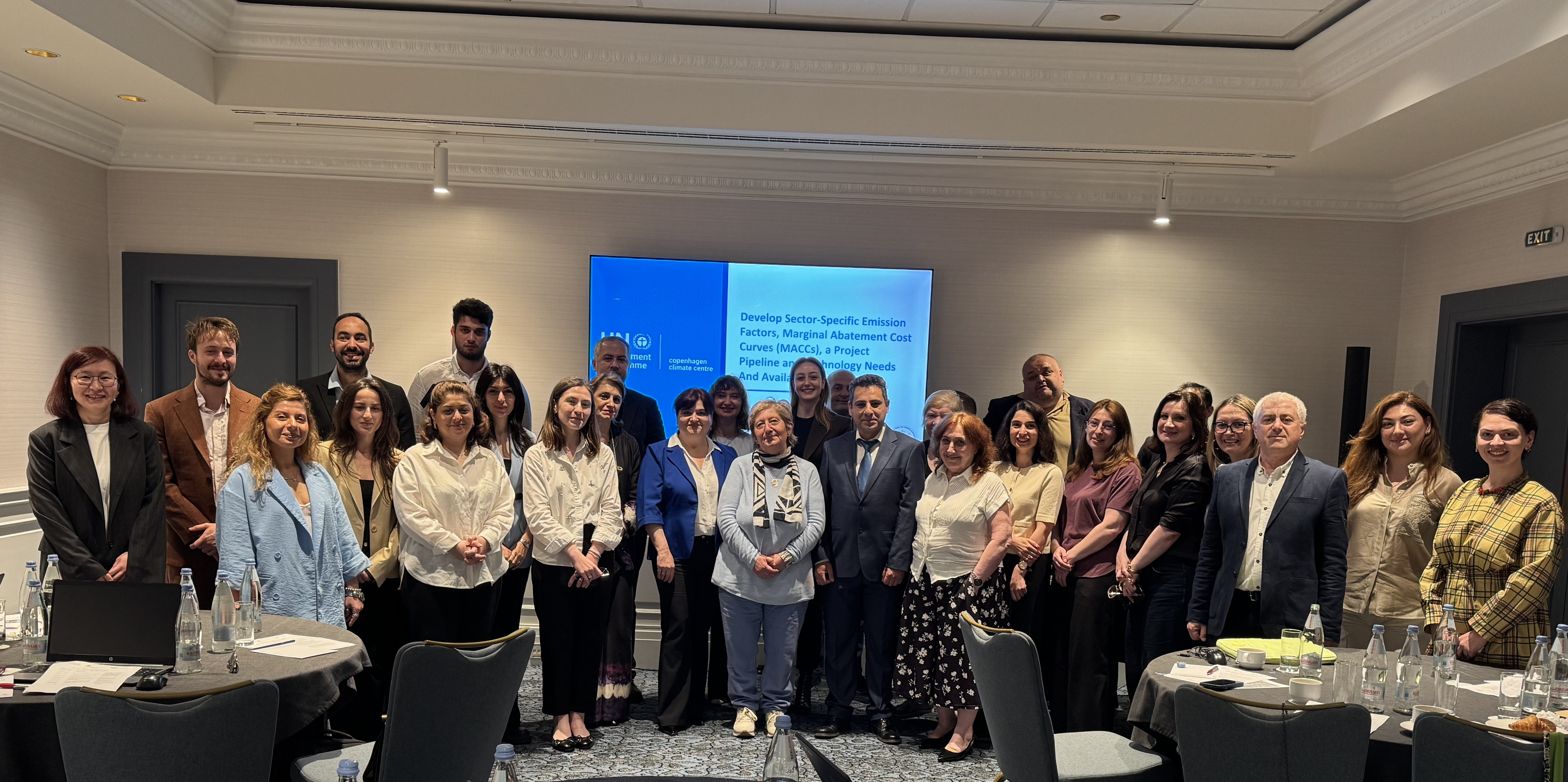
The inception workshop for the Cost-effective mitigation planning project brought together representatives from government, academia and industry to discuss the analytical tools and data needed to support implementation of Georgia’s NDC 3.0, and to provide quantitative assessments for the formulation of a strategy for participating in carbon markets under Article 6 of the Paris Agreement.
Funded through the NDC Partnership Action Fund, the project will support the Ministry of Environmental Protection and Agriculture in developing sector-specific baseline emission factors, marginal abatement cost curves, a climate project pipeline and a Technology Needs Assessment. Together, these outputs will help identify the most cost-effective mitigation opportunities, strengthen project development and support investment planning across key sectors of the economy.
Commenting during the opening of the event, Maia Javakhishvili, Deputy Head of the Environment and Climate Change Department at the Ministry of Environmental Protection and Agriculture of Georgia, highlighted the importance of strengthening the country’s climate planning and reporting capabilities.
“This project will provide quantitative assessments to support the operationalization of Article 6, promote investments in climate change projects in Georgia, and strengthen enhanced transparency reporting.”
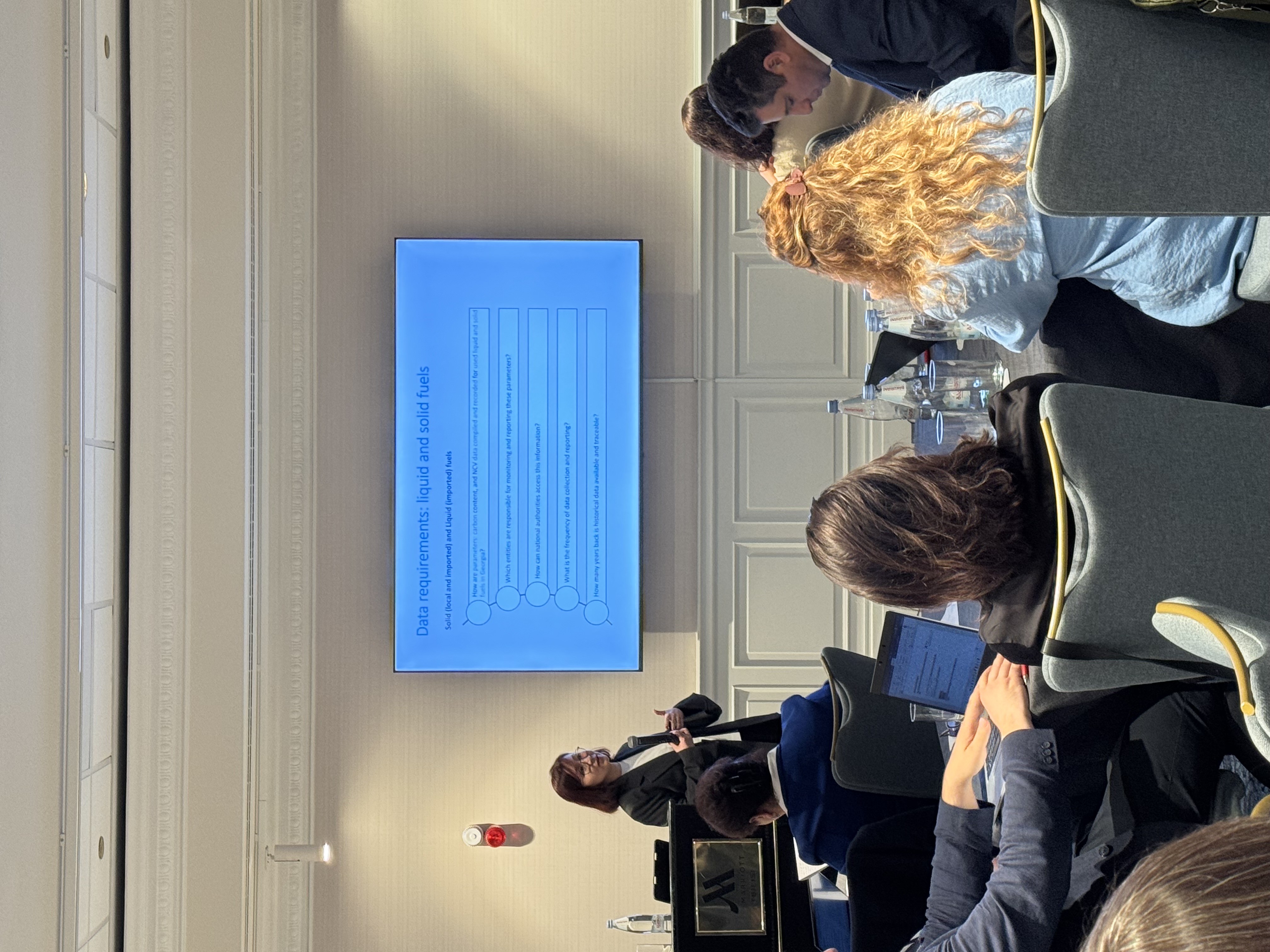
During the workshop, UNEP Copenhagen Climate Centre experts presented the project’s objectives, methodology and workplan, including approaches for technology needs assessment, climate project identification and the development of marginal abatement cost curves. Stakeholders also reviewed preliminary analyses and discussed data requirements and opportunities for collaboration throughout the project.
The project is expected to provide a stronger evidence base for climate decision-making while supporting Georgia’s efforts to attract investment and accelerate implementation of mitigation actions.
Building national capacity with GACMO
Following the inception workshop, a two-day training on the GACMO tool marked the launch of the ICAT project, implemented by UNEP Copenhagen Climate Centre. Building national capacity to use GACMO is a key component of the ICAT project, which supports Georgia in updating its National Climate Strategy and Action Plan and establishing an NDC tracking system aligned with the Paris Agreement’s Enhanced Transparency Framework.
The GACMO tool is used to develop greenhouse gas emissions projections and assess the impact and cost-effectiveness of mitigation measures, and was developed by The UNEP Copenhagen Climate Centre.
The training equipped participants with practical skills to use GACMO for emissions modelling, mitigation analysis and climate planning. Through a series of hands-on exercises, participants worked with data on energy demand, emissions inventories, growth rates and business-as-usual scenarios before exploring mitigation options across the power, household, transport and forestry sectors.
Participants also learned how to analyze marginal abatement cost curves, compare mitigation scenarios and use GACMO outputs to support national reporting processes, including Biennial Transparency Reports under the Enhanced Transparency Framework of the Paris Agreement.
By strengthening national expertise in emissions projections and mitigation assessment, the training will help Georgian institutions better evaluate climate policies, prioritize actions and monitor progress towards national targets.
From climate ambition to implementation
Together, the NDC Partnership Action Fund and ICAT projects demonstrate the importance of combining strategic planning with technical capacity building.
While working directly with identification of priority mitigation opportunities, technologies and investment needs with NDC Partnership support, the GACMO training has strengthened the capacity of national experts to quantify impacts, assess options and track progress over time.
By supporting both planning and implementation, UNEP Copenhagen Climate Centre is helping Georgia build the foundations needed to achieve its climate targets and deliver on the ambitions set out in its NDC 3.0.
Share this
Tags: climate transparency, Georgia, ICAT
ABOUT ICAT
The Initiative for Climate Action Transparency (ICAT) supports improved transparency and capacity building under the Paris Agreement. ICAT integrates guidance, capacity building and knowledge sharing to engage countries in the use of a common framework to assess the impacts of their policies and actions and report progress, fostering greater transparency, effectiveness and ambition. ICAT’s approach is country led.