Globally, communities are facing another year of extreme temperatures, and the urgency of addressing heat-related risks has never been clearer. In recent weeks, countries including France, Spain, Italy and Greece have experienced prolonged heatwaves, triggering health alerts, disrupting daily life and placing additional pressure on healthcare systems, energy infrastructure and vulnerable communities. Emerging economies face particularly acute exposure: rapid, often informal urbanization, large outdoor and informal workforces, and limited access to reliable cooling and healthcare combine to make extreme heat one of the most pressing development and public health challenges of the coming decade.
In 2026, heatwaves around the world once again demonstrated that extreme heat is not only a climate challenge but also a major public health emergency, requiring coordinated action across health, energy, buildings, urban planning and climate.
Extreme heat is now one of the deadliest climate-related hazards globally. It contributes to increased mortality and morbidity from cardiovascular, respiratory and kidney diseases, exacerbates existing health conditions, affects mental health and reduces labour productivity. Older adults, infants and children, outdoor workers, people living with chronic diseases, and those without access to adequate cooling are particularly at risk.
The challenge extends far beyond individual heat events. Heatwaves are becoming more frequent, more intense and longer-lasting as the climate warms. At the same time, rapid urbanization and the urban heat island effect are increasing exposure, particularly in densely populated cities where temperatures can remain dangerously high during both day and night. This is felt with particular force in the fast-growing cities of Africa, Asia and Latin America, where informal settlements, limited green space and constrained access to electricity and cooling leave residents with few options to escape the heat.
This pattern follows the warning set out in the UN Secretary-General’s 2024 Call to Action on Extreme Heat, supported by the World Meteorological Organization and other UN entities, which highlighted the growing socio-economic, environmental and human threats posed by extreme heat.
“A drought can quickly become a food crisis. A storm can become a debt crisis. A heatwave can become a public health emergency.”
— António Guterres, UN Secretary-General, special address at London Climate Action Week, 23 June 2026
Protecting people from heat requires a comprehensive response that combines public health preparedness, sustainable cooling solutions, energy efficiency and climate-resilient urban development.
Energy Efficiency and Nature-Based Solutions: Essential Tools for Heat Resilience
Energy efficiency and nature-based solutions offer some of the most effective and sustainable pathways to reduce heat exposure while supporting climate and development goals.
- Mandatory Minimum Energy Performance Standards (MEPS): MEPS and energy efficiency labels for appliances in markets including the United States and the European Union have reduced the energy consumption of air conditioners.
- High-efficiency air conditioners: the typical air conditioner sold today is less than half as efficient as the best-performing models available, meaning consumers can reduce both electricity costs and emissions by choosing more efficient units.
- Demand response programmes: these allow cooling equipment to adjust energy consumption according to real-time electricity demand, easing pressure on grids during peak periods. A pilot programme using intelligent appliances in the Republic of Korea improved electricity savings by 24%.
- Urban green spaces: parks, green roofs and green walls reduce ambient temperatures, provide shade, reduce the urban heat island effect and improve air quality. Cities including Singapore and Barcelona have incorporated extensive green infrastructure for this purpose.
- Tree planting and forest conservation: trees provide cooling through shade and transpiration. Initiatives such as the Great Green Wall in Africa combine landscape restoration with cooling benefits for local communities.
- Wetlands restoration and sustainable agriculture: wetlands regulate temperature and humidity and support flood control and water purification, while agroforestry and related practices create cooling microclimates in rural areas.
Importantly, these measures provide multiple benefits beyond cooling, including improved air quality, reduced greenhouse gas emissions, enhanced biodiversity, better mental health and increased resilience to floods and droughts.
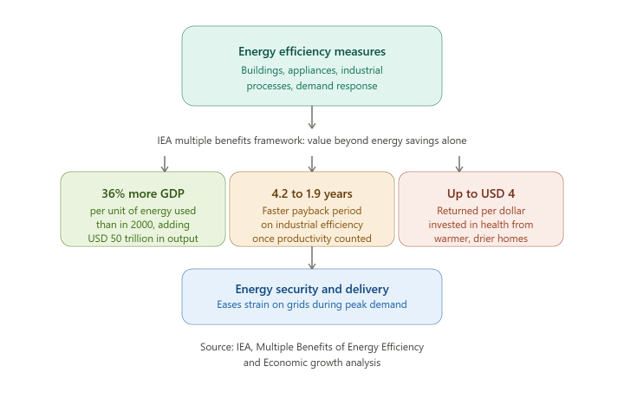
For a deeper dive into these themes, listen to “Heat Waves: Energy Efficiency and Nature-Based Solutions,” an episode of UNEP Copenhagen Climate Centre’s Scaling Up Energy Efficiency podcast series featuring experts from the Danish Meteorological Institute and the International Energy Agency.
Strengthening Heat–Health Action Plans
Recognizing the growing threat of extreme heat, the World Health Organization (WHO) recently launched the second edition of its Heat–Health Action Plan (HHAP) Guidance. UNEP Copenhagen Climate Centre contributed as a co-author to the guidance, helping to develop recommendations on reducing heat exposure through sustainable cooling, energy-efficient buildings, urban planning and nature-based solutions.
The Guidance is structured around eight core elements: governance; heat–health warning systems; populations at increased risk; communication; health system resilience; reducing heat exposure; heat–health surveillance; and monitoring, evaluation and learning. UNEP Copenhagen Climate Centre’s contribution focused principally on the “reducing heat exposure” element, where the Centre’s expertise in energy-efficient cooling, building performance and nature-based solutions translates public health objectives into concrete technical measures that governments and cities can implement.
A people-centred approach to cooling
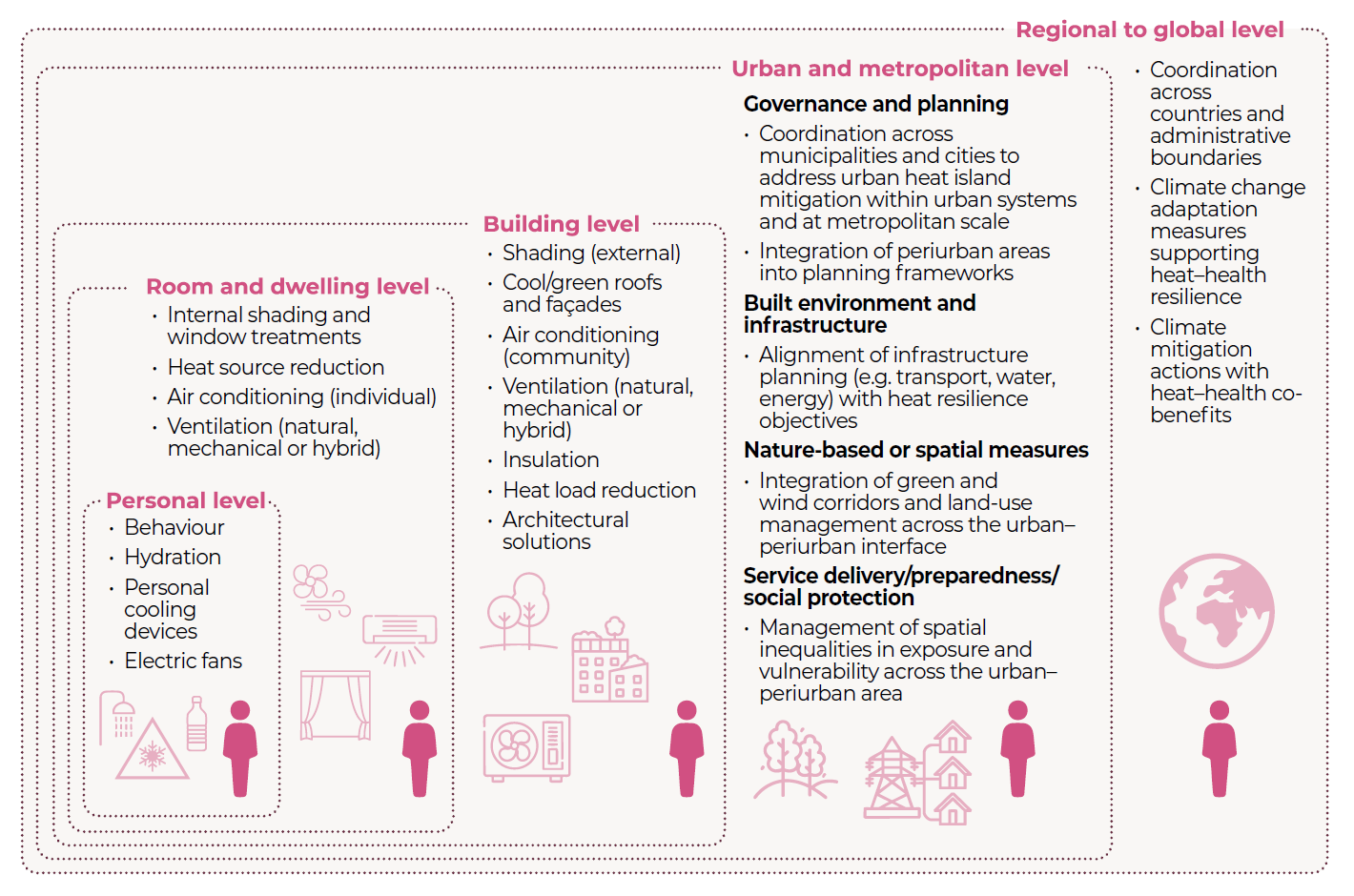
The updated guidance promotes a people-centred approach to heat resilience, emphasizing the protection of those most vulnerable to heat-related illness while encouraging action across multiple scales, from individuals and households to buildings, cities and national governments. UNEP Copenhagen Climate Centre’s contribution to this element reflects a core principle: cooling should be designed around the people who need it most, not only around technologies or buildings.
In practice, this means prioritizing access to cooling for older adults, infants and young children, outdoor and informal workers, people with chronic illnesses, and residents of informal settlements and low-income housing, who are often the least able to avoid heat exposure or recover from it. It means favouring passive and low-cost measures, such as shading, ventilation, reflective roofing and urban greening, that reduce indoor and outdoor temperatures without requiring expensive equipment or reliable electricity supply, which is not guaranteed in every setting. And it means pairing infrastructure investment with last-mile reach: cooling centres, outreach to isolated or at-risk residents, and risk communication adapted to local languages, literacy levels and ways of receiving information.
This approach builds on UNEP Copenhagen Climate Centre‘s existing work supporting countries and cities, including in Africa, Asia and Latin America, to develop urban cooling action plans and to integrate sustainable cooling into national climate and development planning. It complements UNEP’s wider Cool Coalition initiatives, such as the Africa Centre of Excellence for Sustainable Cooling and Cold-Chain, which is expanding access to cooling for health and food security in Africa and India, and city-level efforts to integrate cooling into urban masterplans in countries including India and Viet Nam.
The guidance highlights that reducing heat exposure cannot rely solely on emergency responses. Long-term resilience requires integrating heat considerations into urban planning, housing policies, health systems, building regulations, social protection programmes and climate adaptation strategies. It also stresses the importance of heat early warning systems, cooling centres, targeted outreach to vulnerable populations and coordinated action across sectors.
UNEP Copenhagen Climate Centre’s Contribution
UNEP Copenhagen Climate Centre supports countries and cities in developing practical solutions to reduce heat exposure while advancing sustainable development goals.
This includes promoting energy-efficient cooling technologies, supporting district cooling systems, strengthening building performance, integrating heat considerations into urban planning and accelerating the deployment of nature-based solutions that provide sustainable cooling benefits. Much of this work is concentrated in countries where the gap in access to safe cooling is greatest, including in Sub-Saharan Africa, South and Southeast Asia, the Pacific, and Latin America and the Caribbean, where the Centre supports governments to design urban cooling action plans and integrate cooling into Nationally Determined Contributions and national adaptation plans.
By combining public health protection, energy efficiency and climate resilience, these approaches can help societies cope with rising temperatures while reducing emissions and improving quality of life.
An Urgent Call to Action
Extreme heat is no longer a future risk. It is a present and growing public health challenge affecting communities around the world.
Governments, cities, businesses and communities must act now to strengthen heat resilience through integrated approaches that protect health, improve access to sustainable cooling, reduce energy demand and transform urban environments.
The solutions already exist. The challenge is scaling them rapidly enough to protect people in an increasingly hotter world.
