Climate change is causing losses that extend far beyond economic costs. Impacts on health, cultural heritage, biodiversity, livelihoods, ecosystems, social cohesion and community identity are becoming increasingly evident, yet these non-economic losses and damages remain difficult to assess and are often insufficiently reflected in national policies and planning.
To address these challenges, the Symposium on Loss and Damage – Advancing Non-Economic Losses: Data, Policy, and Capacity for Action brought together governments, experts, UN entities, civil society, academia and community representatives in Bonn on 4–5 May 2026.
The symposium was co-organized by the United Nations Office for Disaster Risk Reduction (UNDRR), the United Nations Environment Programme (UNEP), the United Nations Development Programme (UNDP), and the UNEP Copenhagen Climate Centre as part of a One UN collaboration to strengthen implementation of the UNFCCC Loss and Damage agenda.
Across two days of discussions, participants explored practical approaches for improving data, strengthening governance, building institutional capacity and expanding access to finance for addressing non-economic losses and damages. The event also fostered dialogue between countries and key institutions under the international Loss and Damage architecture, including the Warsaw International Mechanism Executive Committee, the Santiago Network and the Fund for Responding to Loss and Damage.
The discussions highlighted that non-economic losses are multidimensional, context-specific and interconnected, requiring approaches that combine scientific evidence with qualitative, participatory and Indigenous knowledge. Participants also emphasized the need for stronger institutional coordination, clearer policy frameworks and greater investment in community-led approaches that recognize the lived experiences of those most affected by climate change.
Key priorities for country action
The symposium identified several priorities to help countries strengthen responses to climate-related loss and damage, including:
- Improving data and evidence on non-economic losses through integrated and context-specific assessment methods.
- Strengthening governance by embedding loss and damage into national climate, disaster risk reduction and development policies.
- Supporting locally led and inclusive approaches that place communities and Indigenous Peoples at the centre of decision-making.
- Expanding accessible and sustained financing to enable long-term action and stronger institutional capacity.
- Enhancing collaboration across international mechanisms to better support country implementation.
The outcomes of the symposium will help inform ongoing work under the Warsaw International Mechanism and contribute to stronger policy guidance, knowledge sharing and country support on non-economic losses and damages. They also reinforce the importance of integrating these impacts into national planning, monitoring and financing frameworks as countries strengthen climate resilience.
New guide launched to strengthen national responses
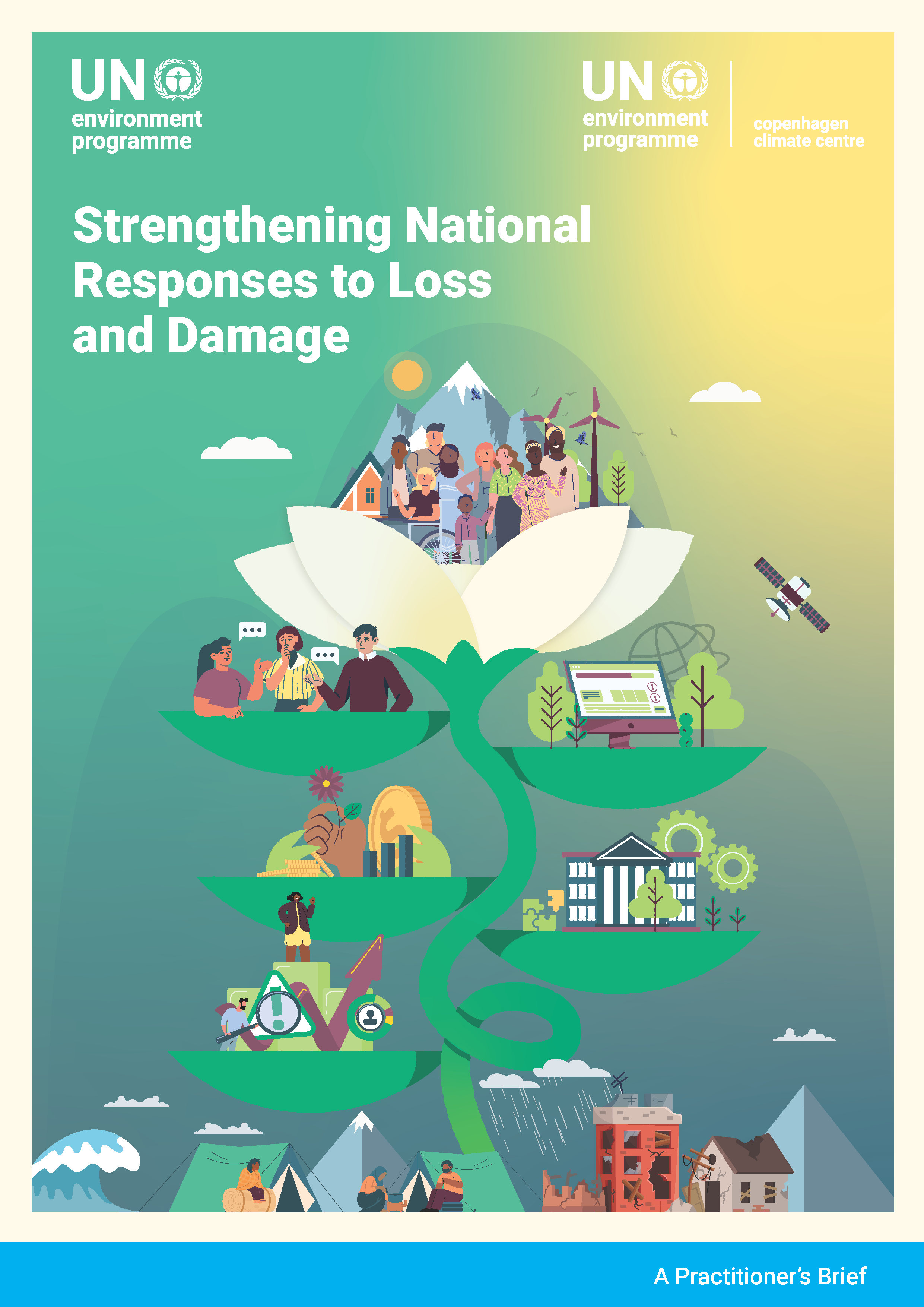
During the symposium, UNEP and UNEP Copenhagen Climate Centre officially launched the new publication, Strengthening National Responses to Loss and Damage.
Developed in collaboration with leading experts and practitioners, the guide provides policymakers, practitioners and partners with a practical framework for understanding, assessing and responding to climate-related loss and damage, with particular attention to non-economic losses and damages.
The publication brings together country experiences, evidence and practical tools to help governments:
- assess climate risks through a comprehensive risk management approach;
- integrate loss and damage into national policies and planning processes;
- identify and diversify financing options;
- strengthen monitoring, evaluation, reporting and learning systems; and
- promote inclusive and locally led responses.
The guide represents an important contribution to advancing evidence-based policymaking and supporting the practical implementation of the global Loss and Damage agenda.
Download the publication: Strengthening National Responses to Loss and Damage.