Access to climate-resilient technologies is critical for helping developing countries adapt to increasingly frequent and severe climate impacts. Through its global Technology Needs Assessment (TNA) programme, UNEP Copenhagen Climate Centre supports countries prioritize adaptation technologies and translating these priorities into investable projects that can attract international funding and deliver tangible benefits on the ground.
The fifth round of the TNA project has reached an important milestone, with participating countries completing the first stage of the TNA process and identifying priority technologies to address national climate change mitigation and adaptation priorities and support the implementation of their NDCs and NAPs.
A mapping of priorities among the 17 countries in the fifth round reveals a relatively balanced distribution between mitigation and adaptation. Of all prioritized technologies, 54% focus on mitigation actions, while 46% address adaptation needs, highlighting countries’ efforts to both reduce greenhouse gas emissions and strengthen resilience to climate impacts.
From planning to finance
The TNA support has already helped mobilize significant adaptation investments through previous rounds of the project. In Fiji, the TNA process contributed to the development of a US$5.7 million project to build nature-based seawalls along vulnerable coastlines, helping protect around 30,000 people from storms and sea-level rise.
In Madagascar, the TNA project helped underpin a US$151 million climate adaptation initiative that is expected to benefit approximately 4 million people through climate-resilient agriculture, improved market access, and enhanced food security.
Together, these examples demonstrate how technology planning can help countries move from identifying adaptation needs to securing the resources needed for implementation and impact.
Agriculture and energy
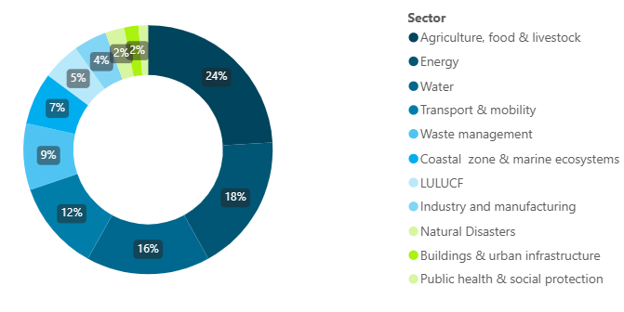
An analysis of the 17 countries and their priorities show that agriculture, food and livestock (24%) are the most prioritized sectors, followed by energy (18%), water (16%), and transport and mobility (12%). Priority sectors also include waste management, coastal and marine ecosystems, industry and manufacturing, buildings and urban infrastructure, natural disasters, and public health and social protection. The priorities underscore the broad development relevance of climate technologies and the focus on integrated, cross sectoral approaches to climate action.
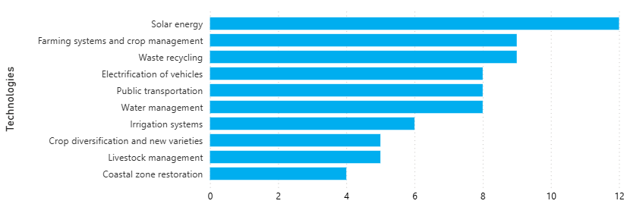
Among the most frequently prioritized climate technologies, solar energy ranked highest, reflecting its central role in advancing clean energy transitions. Other highly ranked technologies include sustainable farming systems and crop management, waste recycling, vehicle electrification, public transportation, and water management. For adaptation, countries highlight the importance of irrigation systems, crop diversification and new crop varieties, livestock management, and coastal zone restoration.
As countries move into the next stage of the TNA process, they focus on identifying barriers to the deployment and diffusion of these technologies and developing enabling frameworks and action plans to support implementation. These efforts help translate technology priorities into tangible investments and actions, supporting NDC implementation while strengthening national climate strategies and access to finance and technical assistance.
Opportunities for interested countries
The TNA project is funded by the Global Environment Facility (GEF), and eligible countries can use their GEF STAR allocations to participate. Through the process, countries receive technical support to identify technology priorities, develop implementation pathways, and strengthen the foundations for climate technology deployment and investment.
As countries move from climate commitments to implementation, understanding which technologies are needed, where they are needed, and how they can be financed is becoming increasingly important. Technology Needs Assessments provide a proven mechanism for answering these questions and transforming national climate ambitions into practical action.
Countries interested in learning more about the sixth phase of the TNA project, which is currently under preparation, can meet the project team during COP31 in Turkey.